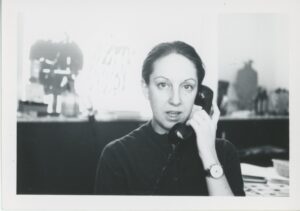

FRIDA SANDSTRÖM
WHOSE AUTONOMY? TRANSLATING CARLA LONZI TODAY
Thursday 23/11 at 17.00 and on zoom LINK
Register at eventi@isvroma.org
Schedule:
17:00 – 17.10: Welcome from the Swedish Intitute
17:10 – 17.30: Frida Sandström: ”Whose Autonomy?”
17:30 – 17.50: Laura Iamurri: ”Of texts and time: reading Lonzi today”
17:50 – 18.10: Luisa Lorenza Corna: ”Translating Lonzi: infidelity, incommensurability and time travelling”
18:10 – 19.00: Discussion
19:00: End
In 1970, art critic and art historian Carla Lonzi abandoned art for separatist feminism. Together with the journalist Elvira Banotti and the artist Carla Accardi she founded the first separatist, anti-authoritarian, and decentralized feminist group in Italy: Rivolta Femminile. Within Rivolta, Lonzi transformed her critique of art to a social critique of the present culture in which she lived and acted. This was a society with a conservative, post-fascist Italian sexual politics, boosted economically by the American Marshall Plan. In this context, Lonzi argued for an autonomous female pleasure and practice, beyond the presupposed universality of the state, the transcendental subject, and the working-class consciousness respectively. This perspective resonates with the ways in which Lonzi before 1970 and throughout the 68-movement had defended artistic autonomy beyond the universality of the art critic and its concept of art history. (Lonzi 1963, 1964, Lonzi 1970).
In Lonzi’s terms, the modern critical subject was in an inherent crisis from within social critique must be formulated (“La critica è potere,” 1970). Her and Rivolta Femminile’s collective writing and editorial practice can be described as an anti-dialectical assemblage of a female collective historical consciousness otherwise ignored in society. It was from the point of view of this consciousness that Rivolta’s critique of society was formulated heterogeneously. As Lonzi makes clear in the seminal text “Sputiamo su Hegel,” from 1970, the experience of social stigmatization was the point of departure of the female revolt, whose separatism was historical rather than strategic, and practical rather than metaphysical. Lonzi describes her and Rivolta’s standpoint as a point of view of the ‘unexpected’, which could be understood as a form of subjectivity ‘beyond the concept’ (De’Ath 2018). In their first manifesto, also from 1970, Rivolta states that they refuse to be objects of study, which in the context of academic studies becomes a theoretical problem for the engagement with their separatism in the present context. Today, sexual, and reproductive rights are again at risk in Italy and internationally, while the crisis of the bourgeois public sphere is at a tipping point between disintegration and neo-fascism.
The proposal for this seminar is to undertake a social reading of Lonzi’s and Rivolta’s writings, which are currently discussed, republished, and translated internationally. How to translate Lonzi and Rivolta historically and politically? This will be the guiding question for the evening, with contributions by Lonzi and Rivolta scholars with specific interest in these issues.
The seminar is conceptualized and put together by Frida Sandström, PhD student and research fellow in art history at the Swedish Institute of Classical Studies in Rome.
CONTRIBUTORS:
Laura Iamurri, PhD, is Full Professor of History of Modern Art, and member of the PhD Program at the Roma Tre University. She has published studies on relationships between art historiography, contemporary art, exhibition politics and art criticism in the 20th century. Iamurri has worked extensively on Carla Lonzi: after the first re-edition of the book Autoritratto (Milan 2010) she edited the ’Scritti sull’arte’ (with L. Conte and V. Martini, 2012); besides a number of essays, she dedicated a monograph to the art historian and critic (Un margine che sfugge. Carla Lonzi and art in Italy, 1955-1970, Quodlibet, Macerata 2016); the small volume dedicated to Giulio Paolini’s Teresa in the part of Joan of Arc in prison, 1969 (Corraini, Mantua 2018) is also part of these studies. She has also worked on the complex knot of relations between women artists, the art system and feminism in the 1970s.
Luisa Lorenza Corna is a lecturer in Art and Visual Culture at UWE Bristol. Her writings have appeared in Parallax, Historical Materialism, Radical Philosophy, Philosophy of Photography Journal. She is a regular contributor to the magazine Art Monthly. Currently she is completing her first book, Fugitive Lives (2023), and editing a collection of texts by the Italian anarchist architect Giancarlo de Carlo. Her and Jamila Mascat’s translation of Carla Lonzi’s writings, Feminism in Revolt, has just been released by Seagull Books.
Frida Sandström is an art critic and PhD student in Modern Culture based at the University of Copenhagen. She is currently working on the PhD thesis, “Art criticism as social critique,” focusing on the social critique of art and sexuality undertaken by Carla Lonzi, Jill Johnston, and Adrian Piper 1955-1975. Since 2015, Sandström is a contributing editor at Paletten Art Journal (SE) and essays and articles are found in Swedish and international journals, magazines, anthologies, and books. In 2021, Sandström was a visiting research student at the Centre for Research in Modern European Philosophy, Kingston University, London. She is currently a research fellow in art history at the Swedish Institute of Classical Studies in Rome.