

OPEN LECTURE
25 may 2023, 18.00
at the Swedish Institute of Classical Studies in Rome and on ZOOM – LINK
Passcode: 011873
ANTONIOS PONTOROPOULOS
Letters and representations of cultural identities in the Alexander Romance: Late antique receptions
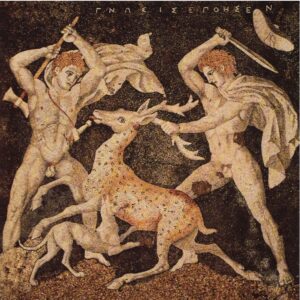 Directly after the death of Alexander the Great (in 323 B.C.E), a series of narratives and legends about his life and works started circulating around the Mediterranean Sea. The Alexander Romance, as it became known in the ancient and late antique world, is a fictionalised biography of Alexander the Great that is rewritten and translated, in both prose and verse, across western and eastern vernaculars. In this lecture, I explore the transmission and cultural reception of the Greek Alexander Romance during the period of late antiquity. Here, I focus on the Byzantine β recension (5th century C.E.), as opposed to the so-called A version. From a literary perspective, these Alexander texts consist of many literary layers: fictional letters, travelogues, heroic quests and wonderous narratives. My principal aim is then to explore the use of fictional letters and epistolary communication in late antique Greek and Latin Alexander traditions. There are around thirty-five fictional letters which circulated either as independent anthologies or as embedded letters in wider narratives. The writers and their receivers are mostly historical individuals linked with the campaigns of Alexander the Great. In both texts, specific literary and/or epistolary motifs (e.g. gift-giving or foreignness) function as signposts, which convey processes of cultural transmission and reception across different historical and literary contexts. I argue that letters function as a privileged site for understanding cultural and linguistic difference. These letters construct a discourse of cultural identity that varies across different linguistic and literary versions of these Alexander narratives. Pagan and barbarian elements are often either omitted totally or rewritten in a new Christian context, emphasizing a gradual process of christianisation. These fictional letters overscore the process of cultural reception of these texts. This project therefore makes an important contribution to the study of cultural identity and reception in the context of the Alexander Romance.
 Antonios Pontoropoulos is a postdoctoral researcher in ancient Greek literature based at the Swedish Institute of Classical studies in Rome and Uppsala University (Gihl foundation postdoctoral research fellow). His current research project concerns the late antique and early Byzantine receptions of the so-called Alexander Romance. He is also working on the publication of a monograph regarding female voices and perspectives in ancient fictional epistolography. His wider research interests cover ancient epistolography, fiction and fictionality in combination with modern feminist and gender studies. He is also very interested in medieval and early modern receptions of antiquity. During 2021, he has been a postdoctoral research fellow at the Swedish Institute where he held the annual research fellowship of the Association of the friends of the Swedish Institute in Rome (Romvännernas storstipendiat). In 2019, Pontoropoulos defended his doctoral thesis on Philostratus’ Erotic Letters and literary representations of eros at Uppsala University. His publications cover the wider scope of Greek Imperial and late antique literature (including Greek Imperial epistolography, the reception of Greek tragedy and Greek Imperial epic).