

Research Seminar
01 Dercember 2022, 17.00, at the Swedish Institute of Classical Studies in Rome and on ZOOM – LINK
ANTONIOS PONTOROPOULOS
Representations of the Dionysiac theme in Plutarch’s Life of Alexander
Plutarch’s Life of Alexander is a biographical narrative about Alexander the Great, in his wider literary and cultural project of the so-called Parallel Lives. Alexander is paired together with the Roman conqueror Julius Caesar. This text is situated in a unique way between the classical Greek lives – which are always read in a very positive manner – and the later Hellenistic lives. The text of the Life of Alexander consists of a series of textual allusions and references drawn from the literary traditions of tragic and epic poetry. The purpose of this presentation is then to explore the employment of the Dionysiac tragic theme in this biographical text. In general, Plutarch, in his biographies, employs various themes drawn from the tradition of ancient Greek tragedy (e.g. the biographical subject as a tragic hero, the Lives as theatrical performances). Here, I wish to argue that the use of this theme functions on different levels, either employed as a rhetorical tool of characterization or as a narrative device signalling prolepsis or as a means of constructing cultural identities. By the specific term, here, I mean a) (minor) references to Alexander as the new Dionysus; b) explicit or implicit allusions to tragic representations of Dionysus; c) references to the motifs of revelry and drunkenness that runs across the narrative. The Plutarchan Alexander balances between an epic and a tragic hero. In my analysis, I read a series of episodes that present the reader with the Dionysiac theme, through the lens of specific literary motifs (e.g. revelry and drunkenness).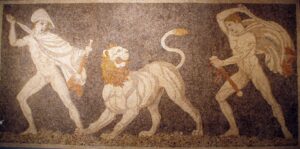
What interests me is not only issues of literary reception and intertextual relations as such, but also their significance for representations of cultural identities: In the context of the narrative, the Dionysiac is often employed in order to construct Alexander’s (and his fellows) identities in the fringes of the civilized (Greek) world and the world of the barbarians. In this sense, the narrator often blurs the crude divide between the Greek and the barbarian. In other words, it is employed more as a tool of cultural analysis by the narrator. On the level of rhetorical characterization too, the Dionysiac theme counter runs a general idea about Alexander’s self-restraint, a literary representation of him as a philosopher king (in other contemporary rhetorical texts). Last but not least, explicit references to Dionysus function mark a darker face in the context of the wider narrative. In all these respects, the use of the particular tragic theme presents the reader with a series of multiple readings.
Antonios Pontoropoulos is a postdoctoral researcher in ancient Greek literature based at the Swedish Institute of Classical studies in Rome and Uppsala University (Gihl foundation postdoctoral research fellow). His current research project concerns the late antique and early Byzantine receptions of the so-called Alexander Romance. He is also working on the publication of a monograph regarding female voices and perspectives in ancient fictional epistolography. His wider research interests cover ancient epistolography, fiction and fictionality in combination with modern feminist and gender studies. He is also very interested in medieval and early modern receptions of antiquity. During 2021, he has been a postdoctoral research fellow at the Swedish Institute where he held the annual research fellowship of the Association of the friends of the Swedish Institute in Rome (Romvännernas storstipendiat). In 2019, Pontoropoulos defended his doctoral thesis on Philostratus’ Erotic Letters and literary representations of eros at Uppsala University. His publications cover the wider scope of Greek Imperial and late antique literature (including Greek Imperial epistolography, the reception of Greek tragedy and Greek Imperial epic).