

Research Seminar
22 September 2022, 17.00, at the Swedish Institute of Classical Studies in Rome
Christian Mühlenbock
Saint Nicolaus of Edsleskog and the role of the catholic church in 12th century Sweden.
In the late 12th century, a local priest, Nicolaus, was brutally murdered on his way to administer last rites to a dying man. In the wake of his death, miracles occurred, and a local cult emerged among the local inhabitants of Västergötland. People started to come in great numbers to Edsleskog in Dalsland, a remote, wild, and untamed part of western Sweden. A contested no-man’s land between the kingdoms of Norway and Sweden. The fate of Nicolaus as a martyr priest soon came to the attention of the Bishop of Skara and a magnificent church was built to host the relics of Nicolaus. The archaeological evidence suggests that the cult gained more and more traction in the early 13th century and in 1220 Bishop Bengt of Skara travelled to see the pope in Rome. One of his objectives was to get the pope´s support for a canonization of Nicolaus. To his disappointment, Pope Honorius III did not concur with Bengt’s ambitions, but Nicolaus subsequently received ecclesiastical honours and thus became a local saint.
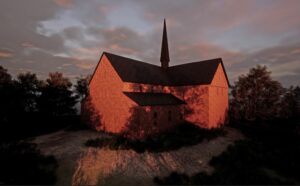 Nicolaus’ church was constructed as a large Romanesque basilica made of brick, the oldest brick building in medieval Sweden – several decades before the arrival of the Mendicant orders, previously acknowledged as the introducers of brickmaking. And at least for 350 years Edsleskog became a hub for pilgrimage, ecclesiastical administration, and a currency-based economy. The example highlights the role of the Catholic church as a colonising force that not only claimed “new” territory but also introduced and promoted several important inventions to the Swedish society such as local saints, money, and the brick building technology.
Dr Christian Mühlenbock has a doctoral degree in Archaeology from the University of Gothenburg obtained in 2008, and has previously worked extensively with Archaic colonisation on Sicily and in Cyprus. Currently on leave from the position as museum director at Lödöse Museum, Västergötland, Sweden, to work with a project on early medieval Dalsland. The focus for Mühlenbock’s present research is the time period from the 12th to the 13th century when Sweden evolved from a fragmented and loosely organised confederation of competing families and regions to a proper kingdom in the 13th century. Of particular interest is an examination of the role of the Catholic church in this process and what role the Church played in marginal areas such as Dalsland/Värmland.