

Research Seminar
15 September 2022, 17.00, at the Swedish Institute of Classical Studies in Rome
Gustav Zamore
Contested Authority: Sacred Space, Conflict, and Material Culture in High and Late Medieval Western Europe
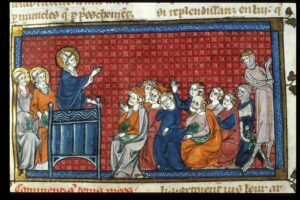 Medieval Christian sacred spaces were, in theory, exceptional zones, free from violence and bloodshed. But they were also material expressions of orthodoxy, power, and authority that sought to shape the faith and behaviour of the Christian laity. But the laity were not passive recipients of such messaging. Rather, they engaged creatively and subversively with their sacred environs and at times targeted buildings, objects, and liturgies in attacks on ecclesiastical authority. This form of behaviour was, however, not limited to the laity, as clergy often either joined their parishioners, or enacted their internal conflicts in sacred spaces.
In this paper, I will briefly attempt a theorization of sacred space in the high and late Middle Ages, before examining the various conflicts and practices of resistance that targeted such spaces and in particular the material objects associated with them. Through a transregional comparison with examples taken mainly from England, France, and Italy, I will explore an understudied aspect of medieval religious culture that involved both laity and clergy. Sacred space, I argue, was an arena that offered a reservoir of symbols, gestures, and objects with which power and authority were contested.
Dr Gustav Zamore obtained his D.Phil in History from the University of Oxford in 2017, he is currently a Marie Skłodowska-Curie Fellow at the Faculty of History at the University of Cambridge and a Research Fellow in the Arts and Social Sciences at Clare Hall. His research covers social history as well as the intellectual and religious cultures of the high and late Middle Ages.