
ITALY AND CYPRUS IN ANTIQUITY: A FRESH LOOK
International Symposium
At the Swedish Institute of Classical Studies in Rome
16-17 may 2023
Held under the auspices of the Embassy of the Republic of Cyprus in Rome
See the abstracts below or download the full programme
Download PDF
SESSION 1
From vanity to variety. The long journey of archaeologists and archaeology in the route between Cyprus and Italy
Luca Bombardieri (Università di Siena)
While the archaeology of Cyprus appeared an annexe to the adventure of travelling towards the East in the 18th Century, it becomes soon the reason to collect exotica to feed the vanitas of western Europe.
Vanity has a driving role in the formation of any collection of antiquities and the case of the first Italian proto-archaeologists in the 19th Century makes no exception. The collectors Cesnolas and the contemporary collectors are condemned by their insatiability and dissatisfaction to make analogous choices, however different might their respective statuses and context be. These aspects influence how they can collect materials – but not the final result they are aiming at, which is, narcissistically, the collection itself.
A variety of interests, challenges and contradictions makes the contribution of Italian scholars to the archaeology of Cyprus a vivid satura lanx during the 20th Century and it paved the way to a real exchange of expertise and cultural issues.
Reciprocity is now transforming this growing variety of interests into a new network of common scientific relations, which involves Cypriot and Italian archaeologists in the reconstruction of early identity and connectivity between the two countries and across the Mediterranean.
Contextualising Cypriot connectivity with Italy post-1200 BC
Artemis Georgiou (University of Cyprus)
It has long been acknowledged that the disintegration of the ‘Age of Internationalism’ construct at ca. 1200 BC marked a transformative era on a Mediterranean-wide level that impacted severely, among others, the way interregional connectivity and commerce was undertaken. Cyprus’ strategic location in close proximity to the Levantine littoral and Cilicia, as well as the largely unscathed politico-economic landscape of the island in the post-crisis era, favoured the participation of Cypriot-based merchants to the decentralised commercial strategies characterising Mediterranean maritime commerce in this period.
While the commercial links maintained between the Cypriot centres and various communities of the eastern Mediterranean have been extensively explored in the past scholarship, the connections developed with the central part of the Mediterranean have only been fragmentarily addressed so far. The increased deposition of artefacts from the central Mediterranean, predominantly Sardinian, in the Cypriot contexts of the 12th century BC, and coevally, the discoveries of Cypriot artefacts in archaeological contexts within the Italian peninsula and the large islands of Sardinia and Sicily, illustrate that the post-1200 BC era marked a period of intensified connections between these two regions.
This presentation aims to provide a general overview of the evidence for the influx of Cyprus-made goods in Italy, Sicily and Sardinia and, vice-versa, for the flow of goods from the central Mediterranean to Cyprus, under the spectrum of the politico-economic transformations characterising the island in this period. The contribution further aspires to investigate the possible means of communication and elucidate the character of such contacts, addressing the challenges entailed in this endeavour.
Sardinia and Cyprus: an update
Fulvia Lo Schiavo and Mauro Perra (Museo Archeologico “La Casa del Nuraghe Arrubiu”)
Let us recall the beginning of the history of Sardinia and Cyprus connections, that is a paper concerning a western obelos made in the Iberian Peninsula and found at Amathus: a thread of the ‘Southern Mediterranean Route’, already figured out by Lucia Vagnetti as early as 1968, crossing Sardinia, where a fragment of a similar articulated obelos was discovered in a local hoard.
From that time onwards, the relationships between Bronze Age (Nuragic) Sardinia and Cyprus have become no longer hypotheses based on a few similarities, but a large body of evidence: oxhide ingots and beyond, in the framework of Mediterranean metal trade from Cyprus to Sardinia, and recently also Nuragic pottery, consisting in commercial containers in Pyla-Kokkinokremos and fine tableware in Hala Sultan Tekke, from Sardinia to Cyprus.
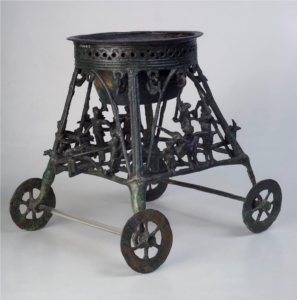
This second case is a document of much more than trade, it shows long-standing mutual contacts based on acceptance and ritual familiarity: Nuragic Recent Bronze Age shallow bowls in the votive pits in the area of the necropolis (some of them, according to the analyses, coming from Nuraghe Arrubiu of Orroli) and in Sardinia the local reproduction of Cypriot LBA bronze tripod-stands. And, beyond, oxhide ingots made mostly from Cypriot copper, but possibly brought to Sardinia in Nuragic ships?
SESSION 2
Late Bronze Age textile production in the Terramare region, the Aegean, and in Cyprus: approaching differences and similarities
Serena Sabatini (University of Gothenburg) and Maria Emanuela Alberti (Università degli Studi di Firenze)
The objective of the symposium is to “whenever necessary, redefine our knowledge and understanding of relations between Italy and Cyprus in antiquity”. The present work focuses on terms of differences and in particular on differences in textile craft during the Late Bronze Age. Traditionally textile studies have had a strong focus on specific case studies and study areas. Although such research tradition provides important results and data, adopting a broad comparative aspect, it has been recently proposed that different textile traditions existed in Bronze Age Europe, including the Italian Peninsula and in the Aegean and Near East, including Cyprus. This works attempts to develop this thesis focusing on differences and similarities between evidence of textiles produced in the Po plain, the Aegean, and Cyprus at the dawn of the 12th century BC. It is argued that investigating differences and similarities in textile production practices has important implications for our understanding of Bronze Age production and trade in textiles in particular, but also of communication and exchange practices throughout the Mediterranean world in general.
Cypriot imports in Etruria in the 1st millennium BC: a reappraisal
Stella Diakou (Istituto Nazionale di Studi Etruschi ed Italici) and Jacopo Tabolli (Università per Stranieri di Siena)
Following the volume “Italy and Cyprus in Antiquity”, published in 2001, there has been an increase of bibliographic references by Italian scholars in “Cypriot” imports in Italy in the 1st millennium BC and especially in Etruria, regarding a variety of different types of data from pottery and metallurgy to funerary ideology and architectural elements. However, these references have two main shortcomings. Firstly, this reference to “Cypriot” imports is almost never really attributed to Cyprus, but, more often than not, it gets lumped with the more generic and inaccurate terms of “Cypro-Phoenician” or “Eastern”. Secondly, these references assume that Cyprus was a politically and culturally unified entity, something that we know did not exist in the 1st millennium BC. In the past 20 years, Cypriot archaeology is undergoing a revision of its interpretation of the Iron Age, adopting a more Cypro-centric perspective, and advocating an understanding of the developments on the island first and foremost from within. This paper will readdress some of the most recent items discovered in Etruria, that have been attributed to Cyprus, and the narratives that have been associated with them, while also looking at their cultural biographies. The purpose of this paper is to problematise the issue of actual and direct imports as opposed to imitations and influences, in the cases that these can be identified, as well as the vectors that might have brought these items to Etruria. Finally, this paper will adopt a dual perspective, by looking at both the Cypriot and the Etruscan context of these imports.
Cyprus between Phoenicia and Italy
Massimo Botto (Istituto di Scienze del Patrimonio Culturale- CNR)
The role played by Cyprus in the contacts between Middle Eastern cultures and Italy between the end of the second and first millennium BC is articulated and continued over time. The function of the island has not only been that of a bridge between East and West but also of a fervent centre of elaboration of cultural contributions of different origins that in Cyprus are modified under the influence of local components and then spread with new vigour in the Mediterranean. In other cases, finally, the Cypriot contributions appear completely original and not documented in the East. The Italian Peninsula represented both for its geographical position and its economic and cultural resources one of the privileged areas of contact with the Cypriot world during the Phoenician irradiation in the Mediterranean. The Cypriot influence is particularly evident during the eighth and seventh centuries BC in the production of sumptuary goods, real status symbols for the local elites. The following contribution aims to investigate in detail some valuable craft categories, from bronzes of ceremonial use to silver cups, sometimes covered with a gold leaf, embossed and engraved.
SESSION 3
New data and a reappraisal of the provenance history of the Cypriot Museum Collections (19th-20th century). ‘Recontextualising’ artefacts from ‘Aradippou’
Silvana di Paolo (Istituto di Scienze del Patrimonio Culturale – CNR)
Aradippou, now on the northern outskirts of the city of Larnaca, was before a village documented on topographical maps since the 17th century AD. As far as we know, this place also began to be explored archaeologically at the time of the British occupation of the island of Cyprus (1879). Since then the generic term ‘Aradippou’ has been associated with many artefacts that ended up in US and European Cypriot collections (19th and 20th centuries). Investigating the evidence that now also includes new data from Italian archives, this paper wants to explore the validity and value of this findspot also in the light of the reconstruction of the settlement network and cultural landscape of the Larnaca area from the Bronze to Classical Ages.
Lost Phoenician inscriptions from Cyprus
Maria Giulia Amadasi Guzzo (Sapienza Università di Roma)
Phoenician inscriptions found in Cyprus come mainly – although not all – from Kition and Idalion. Most of them were found in the 19th and first half of the 20th century and are dispersed in various museums in Europe and the United States. However, a group of the ancient findings have been considered lost already in the CIS I edition, following their often illegal discovery and following dispersion. This contribution will try to illustrate the history of some of them, in particular, two stone inscriptions and a group of bone and shell small objects preserved in Turin and already separately studied in recent years.
The corpora of Cypriot Syllabic scripts of the second and first millennia BC. An update on the publication
Massimo Perna (Università di Sassari)
During a decade of studies from the late ‘90s until 2007, Jean-Pierre Olivier created two databases: one on the Cypro-Minoan script and one on the so-called “Classic” Cypriot script. Thanks to this extraordinary contribution, A. Karnava and M. Perna (with the collaboration of M. Egetmeyer, H. Enegren and E. Markou) have now published the first of three volumes of the Corpus of the “Classical” Cypriot script.
For the Cypro-Minoan script, the reference text has been the Edition holistique des textes chypro-minoens (HoChyMin), published by Olivier in 2007. HoChyMin includes 217 inscriptions, with photographs and drawings mostly reproduced from the original publications, thus providing a reliable transcription of the signs along with Olivier’s expert corrections of the old drawings as required. As Olivier himself remarked, HoChyMin was not meant to be an exhaustive corpus but rather to make as much material as possible available to scholars in the most complete form possible.
In 2013, Olivier entrusted me with this Cypro-Minoan database in order to create the Cypro-Minoan corpus, a commission which was made official at the Copenhagen conference in 2015.
While working on the project, I rediscovered, thanks to R. Zucca, a document of great importance for the history of relations between Sardinia and Cyprus, a pin from a burial in Antas Fluminimaggiore with an engraved inscription dated between the 9th and 8th centuries BC, the period of transition between the two Cypriot scripts.
SESSIONE 4
Decoupling connectivity and maritime mobility. Cyprus and Sicily in the Late Bronze Age
Massimo Cultraro (Istituto di Scienze del Patrimonio Culturale – CNR)
The recent debate about a “minimalist perspective” about the Levantine and Cypriot trade in Central and Western Mediterranean during the Late Bronze Age invites us to (re)define the variability in the distribution of the Mycenaean pottery and other Aegean goods. This paper explores the whole archaeological documentation related to Cyprus and found in different areas of Sicily. The first category is the pottery, including fine tableware and storage containers, found on the southern coastline, i.e. Cannatello and now we add the recent evidence from the Acropolis of Selinous, where a stratigraphical deposit under the Classical levels has given Cypriot pottery. Moreover, this area is of relevant importance for the circulation of large bronze shallow cauldrons, which were set among the burial goods of local figures of high rank, who were the main agents in the trade connections between the island and the Levant. A particular focus will be on a bronze cauldron of Cypriot type found in the chamber tomb at Caldare, near Agrigento; a recent restoration activity has contributed to showing one sign of Cypro-Minoan syllabary incised on the body. Similar signs are attested in an unpublished strainer jug of Cypriot type from Pantalica dated to Late Helladic IIIC. In this paper, we outline a maritime perspective on interaction in the Late Bronze/early Iron Age Mediterranean, where the network implies a variety of social actors who take part in the creation and maintenance of long-distance connections.
The site of Cannatello (AG, Sicily, Italy) and the connectivity from Sardinia to Cyprus in the Late Bronze Age boom-and-crisis years (ca. 1400–1150 BC)
Alessandro Vanzetti (Sapienza Università di Roma), Sara T. Levi (Università degli Studi di Modena e Reggio Emilia; Hunter College, New York) and Domenica Gullì (Soprintendenza BB.CC.AA. di Agrigento)
The archaeological site of Cannatello (AG) has been identified as an emporium, or anyway a site deeply involved in Mediterranean connectivity. In fact, the archaeological materials from the site include Sardinian, Maltese, Cretan, Greek Mainland, Cycladic, Cypriot and Levantine materials, at least. These materials can be attributed on one side to local navigation circuits, but crucially to the long open sea routes from Sicily to Crete proposed by different Authors, among which Cy. Broodbank (Broodbank 2013), since the Mediterranean Late Bronze Age. The evidence is now growing in outlining two major actors in this trading and communication route, Nuragic and Late Cypriot groups, likely the major terminals of connectivity. Cannatello, at the forefront of Sicily, is not only a stepping stone in the process, but it shows peculiar relations with the Nuragic groups, and could act as a local distributor of Mediterranean materials. It is also possible to highlight specific sets of Cyprus-embedded materials, as markers of long-distance connectivity, such as huge pithoi or coarse jars with Cypro-Minoan marks on the handles, as well as White Slip bowls and Base Ring ware. Incidentally, it is notable to remember that in 1990ies V. Karageorghis was called by E. De Miro to identify properly these Cypriot materials. The scientific and typological evidence suggests a strong involvement of Cyprus in the maritime venture, and a growing interest by the Nuragic people during the 13th century BC; Sicilian communities kept pace in the relation. This represents a new step in outlining the forerunners of the Phoenician and Greek colonial enterprise, during the early 1st millennium BC.
Cyprus and Motya. Contacts and exchanges at the dawn of Mediterranean seafaring interconnections
Lorenzo Nigro (Sapienza Università di Roma)
Excavations at Motya by the Sapienza University of Rome during the last two decades have shown that sea routes connecting the east and central Mediterranean were opened already in the 2nd millennium BC and that Cyprus played an important role as a cultural irradiating pole, vehiculating and transforming material culture and ideology. Recent data are illustrated with new open questions concerning the role of Cyprus in the development of pre-Phoenician and Phoenician Motya.