

Research Seminar
19 January 2023, 17.00, at the Swedish Institute of Classical Studies in Rome and on ZOOM – LINK
Lars Karlsson
The Early History of the Etruscans
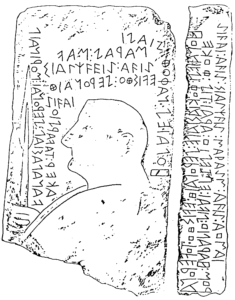 What can we say about the early history of the Etrsucans? Dionysius of Halicarnassus (after Myrsilus of Methymna) writes that the Pelasgians came to Italy from Thessaly. My theory is that the Pelasgians were ”proto-Etruscans”, since the Pelasgian island of Lemnos has inscriptions in Etruscan. Also, the Italian scholar Giulio M. Facchetti has suggested that the Minoan Linear A is “proto-Etruscan”. The German scholar Helmut Rix has proven that the Rhaetian inscriptions in the southern Alps are in an Etruscan language. We thus have an Etruscan-speaking horizon from northern Italy over the Alps to Thessaly and the northern Aegean area (and to Crete!?).
There are many interesting paths to explore here: is the cult of the Kabeiroi an “Etruscan” feature, known from Thebes and many northern Aegean islands? Are the Pelasgians, who became the Philistines in the modern Palestine area, also Etruscan-speaking and thus part of the famous Sea Peoples mentioned at the temple of Ramses III in Medinet Habu?
Why are there so many connections between Italian Etruscan culture and the “Ionic” eastern Aegean area (and to a little extent Egypt, possibly Kabeiroi sanctuary in Faijum)? Architectural terracottas från Larissa and Acquarossa, bucchero from Asia Minor, the many similarities in Etruscan religion, Disciplina Etrusca, with Hittite ritual, especially the interpretations of birds’ flight, animal entrails and thunder? Is there a way to answer these many questions?
Literature:
L. Karlsson, ’San Giovenale. A Terramare foundation’, in Acta Hyperborea 16, Charlottenlund 2022, 19-31.
L. Karlsson, ‘Etruskernas tidiga historia’, Medusa 4, 2020, 21-25.
Lars Karlsson is Professor in Classical Archaeology and Ancient History at Uppsala University. He received his PhD at the University of Gothenburg in 1992 on the thesis Fortification towers and masonry techniques in the Hegemony of Syracuse, 405-211 BC. He was Scientific Assistant at the Swedish Institute of Classical Studies between 1993 and 1999, and thereafter responsible for the excavations at San Giovenale for an additional period of two years. This led to the 2006 publication Area F East. Huts and Houses on the Acropolis. Karlsson has also worked at Morgantina on Sicily, and directed the Swedish excavations at Labraunda, Turkey between 2004 and 2013.