

Research Seminar
10 November 2022, 17.00, at the Swedish Institute of Classical Studies in Rome and on ZOOM – LINK
MOA EKBOM
Urbem praeclaram statui: Dido the builder in Antiquity
The alternative narrative of a chaste Dido, in which she never meets Aeneas, but remains true to her dead husband, was known in Antiquity. The alternative story especially emphasizes the role of Dido as a founder. The Aeneid of course does this as well, with Dido explicitly highlighting this achievement (4.655 urbem praeclaram statui, mea moenia vidi). The chaste narrative does not ignore the Aeneid’s version or verses, but rather engages with them, embracing its parallel status and thereby enhancing and enlarging the reception of Dido and Vergil.
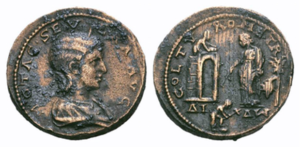 Solidifying the idea of Dido also being regarded as a builder and not a frenzied, jilted lover is the portrayal of her on coins as overseeing the building of Carthage. The city of Tyre, whence Dido sailed to Africa, minted coins with this and similar iconography. The use of this portrayal appears during the Emesan and Severan dynasty, and the earliest coins feature Heliogabalus and his grandmother Julia Maesa. Julia Maesa is the key, since she, and her sister Julia Domna, were, like Dido, local girls who made good, and via Leptis Magna, the hometown of Septimius Severus, an African city like Carthage, has founded an empire. Syria was the arena for the struggle between the usurper Macrinus and Heliogabalus, and the minting asserted loyalty to the winner, as well as underlining their special bond. This reverse of Dido is used for one of Heliogabalus wives, and later emperors, possibly to remind of Tyre’s dynastic claims and clout. Using Dido the builder to highlight one’s connection to and ingratiate oneself with the Emesan family demonstrates that Dido the chaste founder was a well-known and understood entity. The prevalence and legibility of this image of Dido as a builder in is illustrated, and also why the image ceased being used on coins.
Moa Ekbom has a PhD in Latin from Uppsala University. She is the author of The Sortes Vergilianae: A Philological Study. Her interests are Reception studies and Late Antiquity, with a particular interest in the Historia Augusta, Apuleius, and Virgil. She is a former fellow of the Swedish Institute of Classical Studies in Rome.