

Research Seminar
20 October 2022, 17.00, at the Swedish Institute of Classical Studies in Rome and on ZOOM
Tuomo Nuorluoto
Local and translocal identities in Roman Greece. Some observations on the names used by Hellenic elites with Roman citizenship
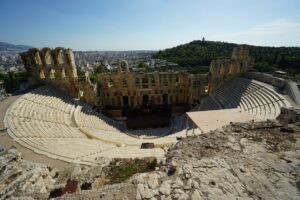 The Roman conquest of the Eastern Mediterranean world had its impact on the local power structures and dynamics. Although most of the Greek cities remained self-governed and retained most of their administrative institutions, they were now, in many ways, politically dependent on Rome. Consequently, the local civic elites now found themselves competing for imperial favour. For their service to Roman magistrates, they were often rewarded with Roman citizenship, which, in turn, paved way for new ways of political advancement and distinction. In time, many Greeks, who now had become increasingly Roman, rose to imperial level prominence and even to the highest offices of the Empire. But as the Greeks were becoming more Roman, the Roman Empire itself was becoming a Greco-Roman state. The prestige of the Greek language and culture in the Roman Empire put the Greek elites in a different position in comparison to many of their Western counterparts, at least in terms of cultural expression and identification. The purpose of my talk is to make some observations on how the names of the Hellenic elites with Roman citizenship could function in different local and translocal contexts as instruments of the construction and negotiation of identity.
Tuomo Nuorluoto is a Postdoctoral Researcher of Latin at Uppsala University, where he also obtained his PhD degree in early 2021. He is currently working on a monograph on Roman female names (to be published in 2023), based on his doctoral dissertation Roman Female Cognomina: Studies in the Nomenclature of Roman Women. Nuorluoto’s research interests include Roman onomastics and prosopography, Latin and Greek epigraphy, various sociolinguistic aspects of the ancient Mediterranean, and Roman social history, and he has published several papers on related themes. At Uppsala University, he teaches Latin language and literature at basic and advanced level and has also lectured in Roman epigraphy, history, and mythology. At the Swedish Institute in Rome, he has been Research Fellow in Philology in 2017 and Lerici Fellow in 2021. He has also been Amos Anderson Fellow at the Finnish Institute in Rome in 2018. The main reason for his current visit at the SIR is to thoroughly investigate an unpublished Latin inscription, located near Rome, for which purpose he is financed by Ingrid and Torsten Gihls fond at the Royal Swedish Academy of Letters, History and Antiquities.