

Research Seminar
9 June 2022, 17.00, at the Swedish Institute of Classical Studies in Rome and on Zoom
Vincenza Ferrara
The Biocultural Heritage of Sicilian Olive Trees
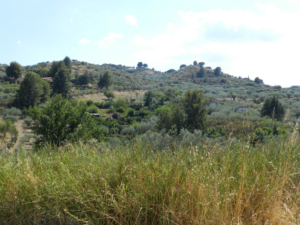
Mediterranean perennial agrosystems are the results of long-term entanglements between humans and nature, playing a crucial role for local livelihood but today critically under pressure due to global market forces and climate change. Sicily represents a unique case for its position, geomorphology and biological diversity of endemic species. The island has been the crossroad of diverse cultures for millennia, which have brought to an extraordinary melting pot of different traditional ecological knowledges. Olive cultivation is the non-discursive result of the long cultural negotiation process among all these different ecological practices crossing the island and the local environment, over the centuries. Before too late, we need to secure the biocultural heritage represented by ancient olive orchards since, thanks to their extraordinary longevity, these long-lasting agrosystems may offer insights on how to tackle adaptation challenges and manage agrobiodiversity sustainably in the future.
In this seminar, I present the new transdisciplinary research project “The Biocultural Heritage of Sicilian Olive Trees” (2021-2024), funded by Vetenskapsrådet and supported by the Swedish Institute of Classical Studies in Rome through the Lerici grant. Early results will be presented, following the three main integrated components of our research: 1) Spatial analysis with contextual remote sensing techniques to reconstruct land-use dynamics of historic olive agrosystems; 2) Local-scale historical-ecological analysis of individual olive trees/stands and reconstruction of climate dynamics; 3) Collection of local ecological memory from unconventional archives (i.e. ecological calendars and plant phenology) and disentangling of land-use dynamics through geonarratives. How far we can ensure the olive biocultural continuity today and in the future in Sicily, as elsewhere, depends on how much we can learn from our own past.
Vincenza Ferrara is an early-stage researcher at the Department of Archaeology and Ancient History, Uppsala University, and the Department of Human Geography at Stockholm University. She is interested in the transdisciplinary investigation of nature-human dynamics at different spatio-temporal scales, combining methods from historical ecology and geospatial analysis to address contemporary agroecological issues. Vincenza is a practitioner herself, owing and managing some ancient olive orchards in the island of Sicily.
Preregister for attendance in person by sending an email to oen@isvroma.org and remember to bring your mask! If you want to follow the seminar via zoom please register here!